16 January 2027
Opening Wednesday, 11 November,
6-8pm
Sherrie Levine
11 November 2026 -
16 January 2027
Galerie Buchholz is proud to announce our second solo exhibition with Sherrie Levine, the first in our New York gallery. The exhibition has been conceived by Sherrie Levine as a constellation of historic works alongside new works produced for this occasion.
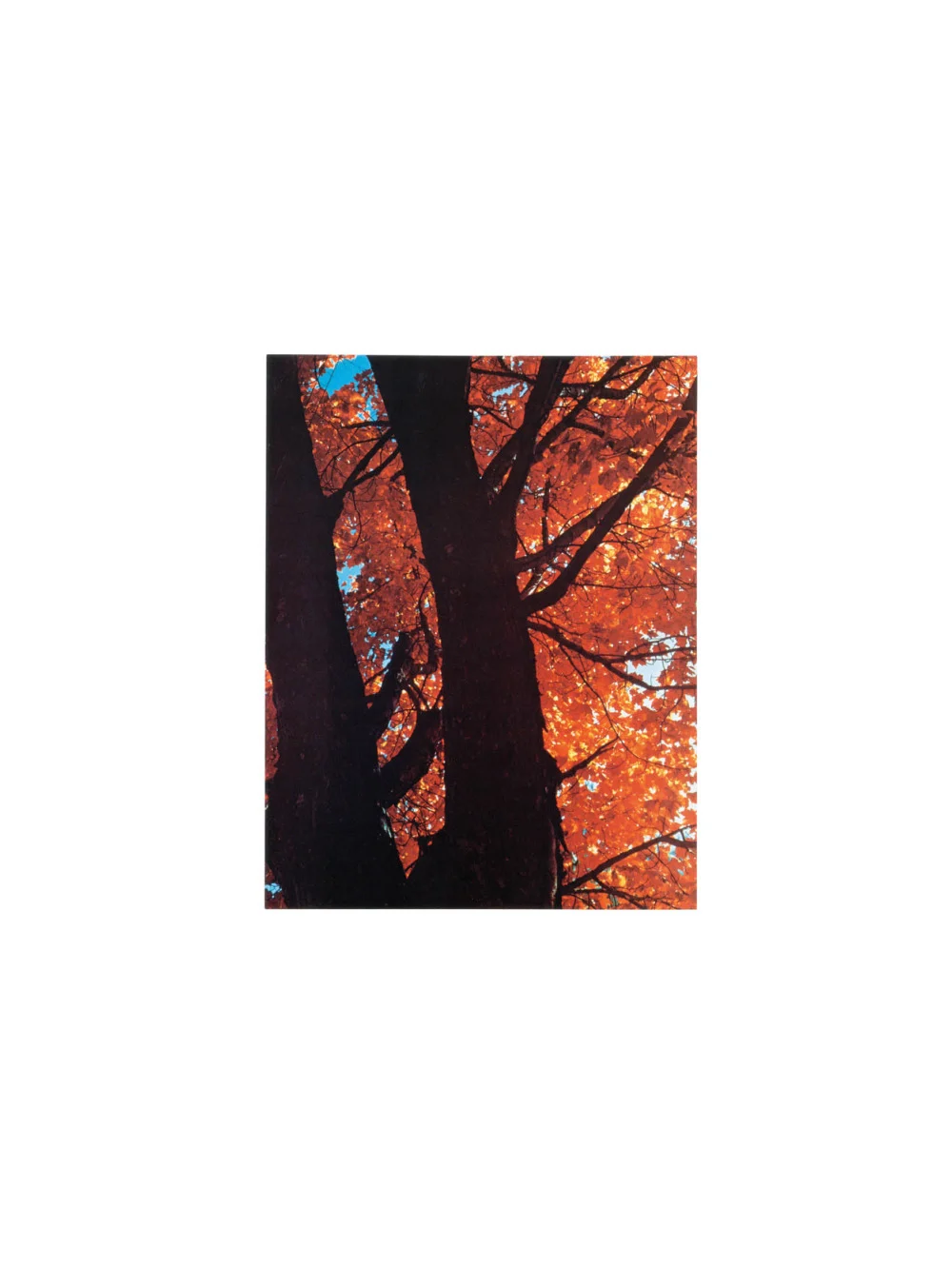
The earliest works in the exhibition are a series of photographic collages from 1979 titled After Andreas Feininger. These are Levine’s first works made entirely from images appropriated from other photographers, preceding by a year her rephotographed works after Eliot Porter and Edward Weston.
Mounted onto standard-sized sheets of paper, the images were taken from several books by the American photographer Andreas Feininger, including his volume Trees. Some were cut directly from the pages of these books, while others were made from tipped-in photographic plates that Levine removed and remounted.
After Andreas Feininger 6 was reproduced in 1980 in the catalogue of Horror Pleni: Pictures in New York Today, an early exhibition of artists from the Pictures Generation, alongside this text by Levine:
Reluctant moralists, we make art that suggests our simultaneous longing for anarchy and order - to have nothing and everything.
An uneasy peace is made between the reassuring mythologies society and culture provide and our wish to see ourselves as free agents. The very best in art makes public our private anguish in the face of this ineluctable conflict.
We want images and stories which present us with ideals but at the same time are not innocent of the other side of the coin - our desire to have no ideals, no fetters whatsoever. We aspire to the best of both worlds.
This approach is also at play in a series of drawings made in 1985 after illustrations from George Grosz’s 1922 book Ecce Homo. In her appropriated works from this time - for example, in her exhibition juxtaposing drawings after Kazimir Malevich with Egon Schiele - Levine tended to associate abstraction with the political, and figurative art and expressionism with apolitical or even reactionary positions. The drawings after Grosz, exhibited here for the first time, complicate these polarities by reproducing an example of politically engaged expressionism.
These bodies of early work are presented alongside new bronze casts of nineteenth-century Asian rice-harvesting boots and clogs, which Sherrie Levine acquired from antique stores before having them cast in bronze. These works reflect her longstanding interest in subjects drawn from outside the traditional boundaries of Western art. The shoe motif also relates to her notorious first exhibition in New York, Shoe Sale (1977), in which she presented a table filled with dead-stock girls’ dress shoes in a storefront in Soho.
Alongside the bronze casts of boots and clogs, Sherrie Levine presents Horse Skull, also from 2026, her first bronze sculpture that is patinated white.
The exhibition also includes Thin Stripe: 1-8, a continuation of the series of Stripes that Levine begun in 1985, as well as Plain Mirror: 1-12, an example of the mirror works that she has been making since 2004. The mirrors give a literal form to the idea of reflection, a central concern of Levine’s work, while also referring to the practice of appropriation itself. Whereas her earlier mirrors were tinted in various colors, the new series is the first to incorporate untinted glass.
The origins of After Piet Mondrian 1: Yellow can be traced back to a 1983 series of rephotographed reproductions of Mondrian paintings that were included in Sherrie Levine’s previous exhibition at Galerie Buchholz in Berlin. Levine’s paintings after Mondrian, based on her own appropriated photographs, invert the original process of appropriation by moving from photography back into painting. In doing so, she introduced a series of chromatic distortions that mirrored those generated by her older techniques of appropriation, in which the colors of the image shifted as it was reproduced photographically in a book and subsequently rephotographed by Levine herself. This is particularly evident in her black-and-white paintings after Mondrian, which mimic the effects of black-and-white photography in the medium of painting. In this most recent iteration of this body of work in her new exhibition in New York, these black-and-white paintings have been translated back into color, but now tinted in a single hue.
Sherrie Levine’s work has been widely exhibited since the 1970s. Last year the Aspen Art Museum presented a major exhibition devoted to her work between the years 1977-1988, curated by Scott Portnoy. Key solo exhibitions have been held at the Neues Museum, State Museum for Art and Design in Nuremberg (2016), the Portland Art Museum in Oregon (2013), The Whitney Museum of American Art, New York (2011), Museum Haus Lange, Krefeld, Germany (2010); San Francisco Museum of Modern Art (2009), and the Georgia O’Keeffe Museum, Santa Fe, New Mexico (2007). Work by the artist is included in museum collections around the world, including The Metropolitan Museum of Art, New York; The Museum of Modern Art, New York; the Whitney Museum of American Art, New York; Solomon R. Guggenheim Museum, New York; the Art Institute of Chicago; Centre Pompidou, Paris; Hirshhorn Museum and Sculpture Garden, Washington, DC; Institute of Contemporary Art, Boston; Louisiana Museum of Modern Art, Humlebæk, Denmark; Los Angeles County Museum of Art; The National Museum of Art, Osaka; San Francisco Museum of Modern Art; and Tate, United Kingdom.

